
Loupit Travel and Expense · Management guide
Corporate travel management
Corporate travel management means organizing business trips with policy, budgets, suppliers and traveler care. Learn how to structure the operation, from requests to expense reporting, and how Loupit connects this journey.
- Multi-agency comparison
- Policy and approvals
- Travel and expenses
What is corporate travel management?
It is the combination of processes, people and technology that plans, approves, books and monitors business travel. Its goal is to balance total cost, productivity, safety and compliance—not just find the cheapest flight.
01
How to implement corporate travel management
Start by assessing your current operation and running a pilot. Implementation should align Procurement, Finance, HR, managers and travelers before expanding adoption.
- Map spending, destinations, frequency, booking channels and traveler challenges.
- Define responsibilities, cost centers, budgets and approval authority.
- Approve suppliers and test bookings, exceptions and expense reporting in a pilot.
- Train users and review performance indicators and support after rollout.
02
Travel policy: clear rules and traceable exceptions
A policy turns company priorities into booking and spending criteria. It should be accessible to travelers and account for situations where the cheapest option does not meet business needs.
- Set domestic and international advance-booking rules, flight classes and accommodation limits.
- Define baggage, transportation, meals, eligible expenses and supporting documents.
- Document who approves exceptions, why and within what timeframe.
- Review policy when operations or market conditions change.
03
Savings: compare total cost, not just the agency fee
Trip cost depends on fares, taxes, included services and commercial terms. A lower quote does not prove realized savings: record the comparable alternative and the actual purchase outcome.
- Compare the same flight, baggage allowance and change and cancellation rules.
- Consider accommodation, transfers and the effect of schedules on productivity.
- Assess payment terms without assuming they always justify a higher price.
- Track booking lead time, policy compliance, changes and savings against a defined baseline.
04
Suppliers and agencies: competition with governance
The agency provides ticketing and support under its contract; the platform organizes processes and data. With Loupit, a company can work with one or several connected agencies and compare offers in the same environment.
- Evaluate service, emergency support, commercial terms and responsibilities.
- Compare equivalent offers from approved agencies available for the search.
- Company- or agency-negotiated fares can be integrated depending on the connection.
- Maintain supplier approval criteria and review service quality, not just price.
05
Duty of care: supporting travelers before, during and after a trip
Duty of care is an organization's responsibility to care for business travelers. Technology and agencies support operations but do not replace the company's responsibility for assistance and incident-response planning.
- Assess destination risks and check travel documents with official sources.
- Define emergency contacts, responsibilities and support channels.
- Arrange insurance and assistance appropriate to the trip profile.
- Organize itineraries and response protocols with access restricted to responsible staff.
06
AI in travel management: efficiency with human approval
Artificial intelligence can support natural-language requests, document reading and operational analysis. Loupit enables access through AI tools connected via MCP, subject to available features and permissions.
- Request trips and consult information through connected AI channels.
- Maintain policy, approval authority and authorization for every action.
- Check dates, passengers, fares and conditions before confirming a purchase.
- Protect personal data and limit access to what the task requires.
07
Expense management and reporting: closing the travel cycle
Expense management covers corporate spending. Financially, a trip is complete only when costs are documented, classified, approved and reconciled.
- Link expenses and receipts to travelers and cost centers.
- Define reimbursement criteria and handling of out-of-policy spending.
- Reconcile invoices and identify discrepancies for review.
- Consolidate bookings and expenses to monitor operational costs.
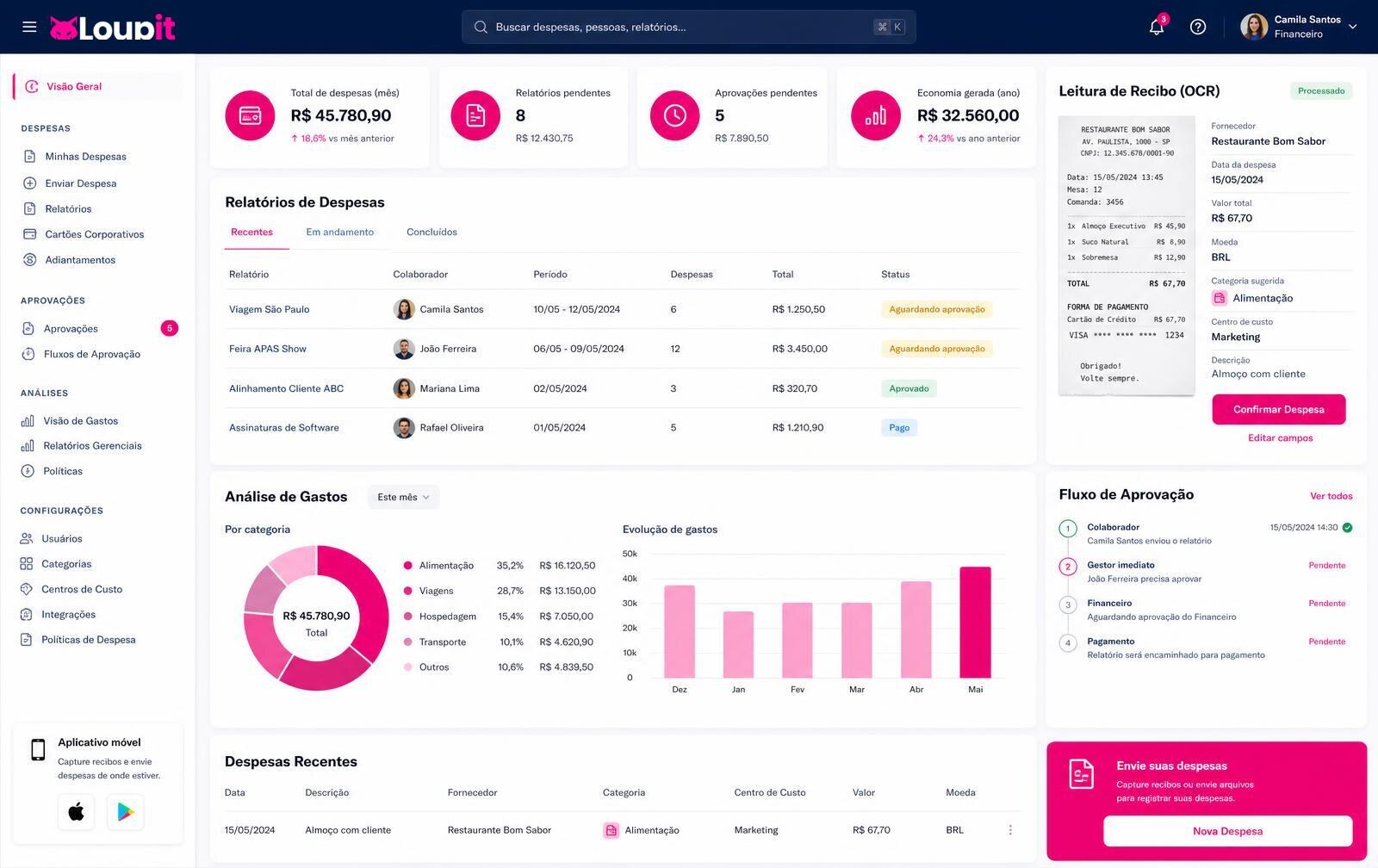
Travel and expenses in practice
Loupit's expense management screen, shown in Portuguese. Evaluate the complete workflow using your company's scenarios.
Frequently asked questions about corporate travel management
Bring management into a connected operation
Explore Loupit's multi-agency model and validate policy, approvals and expenses with your team.